Double Trouble: How Hidden Duplicates in Your Home Are Silently Inflating Your Moving Bill
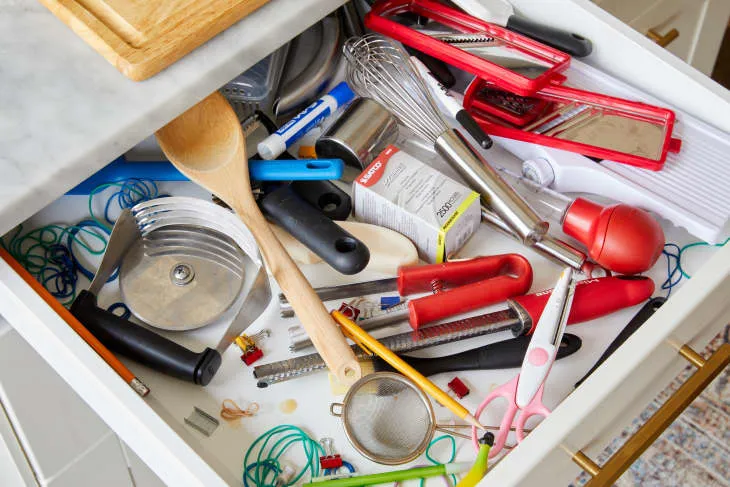
Photo: cluttered kitchen drawer full of duplicate utensils and gadgets before moving, via cdn.apartmenttherapy.info
There is a peculiar phenomenon that occurs in nearly every American household over time. Objects multiply quietly, without ceremony, and without conscious awareness. A second set of measuring cups appears in the back of a cabinet. A drawer accumulates four nearly identical phone chargers. The linen closet holds three sets of sheets for a bed that no longer exists in the home. None of this feels like a problem — until moving day arrives and someone must physically lift, wrap, pack, load, transport, and unpack every single one of those redundant items.
For the average American family, this invisible inventory adds hundreds of pounds and considerable expense to an already costly undertaking. Understanding why it happens, and how to address it before the moving truck arrives, is one of the most financially consequential things a household can do in the weeks before relocation.
The Accumulation Problem Nobody Talks About
Psychologists and consumer behavior researchers have long documented what is sometimes called "unconscious acquisition" — the tendency to purchase items without fully accounting for what is already owned. The phenomenon accelerates during certain life transitions: after a long illness, following a period of remote work, or simply during the busy years when household members stop communicating about shared supplies.
Consider the typical American kitchen. A 2022 consumer survey found that the average household owns between two and four manual can openers, despite regularly using just one. Spatulas, wooden spoons, and vegetable peelers routinely appear in triplicate. Pantry shelves hold duplicate spice jars — often purchased because the original was buried and assumed empty. None of these items carries significant individual weight. Collectively, however, they represent a meaningful volume of material that must be packed, loaded, and transported at the client's expense.
The bathroom tells a similar story. Surplus shampoo bottles, redundant first-aid kits, and backup toiletry supplies purchased during pandemic-era stockpiling still occupy medicine cabinets and under-sink storage across the country. The home office compounds the problem further: charging cables, power strips, outdated electronics, and duplicate stationery supplies accumulate in drawers and closets with remarkable efficiency.
Why Duplicates Are a Moving Expense, Not Just a Storage Problem
Many homeowners understand intellectually that they own too much. What they fail to appreciate is the direct financial relationship between volume and moving cost.
Professional moving companies price long-distance relocations primarily by weight and distance. Local moves are typically billed by the hour, which means additional items translate directly into additional labor time. Either way, every redundant item in a household represents a quantifiable cost — not just the inconvenience of unpacking it at the destination.
A conservative estimate: a household carrying fifty pounds of genuinely unnecessary duplicate items on a 500-mile move might pay an additional $75 to $150 in transportation costs alone. That figure scales considerably for larger households and longer distances. Add the cost of packing materials — boxes, tape, bubble wrap, paper — and the financial case for a thorough pre-move audit becomes difficult to dismiss.
There is also the hidden cost of time. Every duplicate item that travels to the new home must eventually be dealt with: unpacked, evaluated, stored, or discarded. Many families find themselves spending the first weeks in a new home managing clutter that could have been eliminated before departure.
Conducting a Duplicate Audit: A Room-by-Room Approach
The most effective strategy for identifying duplicate inventory is a structured, systematic review of the home — completed well before packing begins. The following framework, refined through years of experience helping clients prepare for relocation, offers a practical starting point.
Kitchen and Pantry Begin by emptying every drawer and cabinet onto a cleared surface. Group identical or functionally equivalent items together. The goal is not minimalism for its own sake, but rather honest accounting. If a household owns four rubber spatulas, a straightforward question applies: will all four be used in the new home? If not, the surplus should be donated, sold, or discarded before the first box is packed.
Bathrooms and Linen Closets Pay particular attention to stockpiled consumables. Surplus soap, shampoo, and cleaning products are among the heaviest and most commonly duplicated categories in American homes. These items are inexpensive to replace and expensive to transport. Evaluate realistically what will be consumed before moving day and plan accordingly.
Home Office and Electronics Storage Charging cables deserve special scrutiny. The average American household owns between ten and twenty cables at any given time, many of which are incompatible with current devices or simply redundant. Conduct a cable audit by matching each cable to an active device. Anything unmatched should be recycled through an electronics disposal program rather than transported.
Garage and Storage Spaces These areas represent the highest concentration of forgotten duplicates in most homes. Tools, seasonal equipment, and hardware supplies frequently appear in multiples, particularly in households where items were purchased without checking existing inventory. A careful review of these spaces often yields the most significant weight reduction of any room in the home.
How Professional Movers Help Clients Navigate This Challenge
At JT Packers & Movers, the pre-move consultation process is designed in part to help clients identify exactly these kinds of inefficiencies. Experienced moving coordinators have seen the pattern thousands of times: a household that believes it has a manageable inventory discovers, through a structured walkthrough, that a meaningful portion of what it owns is redundant, forgotten, or no longer needed.
This is not a judgment about how a household is managed. It is simply a function of how American consumer culture operates. Homes accumulate. Life gets busy. Purchases are made without full awareness of what already exists. The move becomes the moment of reckoning.
Professional guidance during this phase offers several advantages. Movers with significant experience can quickly identify categories of items that consistently add unnecessary cost to a relocation — and can suggest practical thresholds for what is worth transporting versus what is more economically replaced at the destination. For households relocating across state lines, this calculation becomes especially important, as the cost differential between transporting and replacing certain items can be substantial.
The Financial Case for Moving Less
The economics of decluttering before a move are straightforward. Items sold through online marketplaces or estate sales generate revenue. Items donated may qualify for a charitable deduction. Items discarded eliminate a direct moving cost. In each scenario, the household arrives at its destination lighter, less burdened, and better positioned to establish an organized living environment from the outset.
More significantly, the household that moves only what it genuinely needs and uses is the household that settles in most efficiently. The absence of duplicate clutter in a new home is not merely an aesthetic preference. It is a practical advantage that shapes the experience of the first weeks and months in a new space.
The items you forgot you owned are not free to move. They carry a price — in dollars, in time, and in the energy required to manage them at every stage of the relocation process. A thoughtful audit, conducted before packing begins, is one of the highest-return investments any household can make in advance of a move.
When you are ready to take that next step, JT Packers & Movers is prepared to help you move smarter — not just farther.